
Blog
Drawdown Limit Forex Management
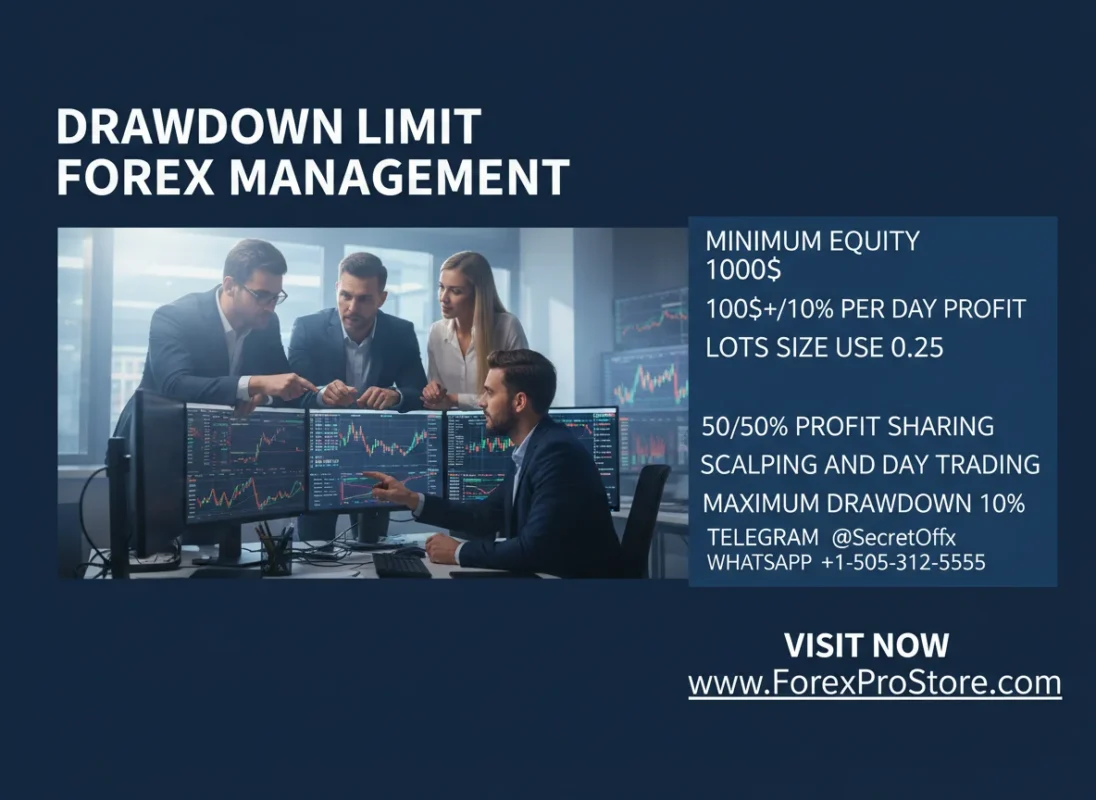
1. Introduction: The Downside Dictates the Upside
When most retail investors explore the currency markets, their eyes are glued to the potential yield. They look for staggering monthly returns and compounding wealth. However, institutional investors operate on an entirely inverted philosophy: they look at the downside first. This is where drawdown limit forex management becomes the most critical concept in algorithmic and managed trading.
What is Forex Account Management? In its simplest form, it is the outsourcing of your trading capital to a professional trader or an algorithmic system. You provide the funds, and they execute the strategy.
Why do investors use this service? Time is the obvious answer, but the underlying reason is psychological preservation. The foreign exchange market processes over $7 trillion daily; it is highly leveraged, emotionally exhausting, and unforgiving of hesitation. Investors use managed accounts to establish an emotional firewall between their capital and the market’s volatility.
In this article, we are stepping away from the typical “passive income” narrative. Instead, you will learn how to evaluate managed accounts through the ruthless lens of institutional risk management. We will dissect how maximum drawdown limits work, why capital preservation trumps aggressive scaling, and how to spot the structural differences between a legitimate money manager and a reckless gambler.
Download Now Non-Repaint Indicator
Telegram Channel Visit Now
Fund Management Services Visit Now
2. What is Forex Account Management?
The Definition
Forex account management is a professional financial service where an experienced trader, a team of analysts, or a quantitative algorithm actively trades a client’s capital in the foreign exchange market. The client retains total ownership of the funds, while the manager operates under a strict legal mandate to execute trades.
How Does it Work?
The mechanics rely on a Limited Power of Attorney (LPOA). When you fund a brokerage account, you sign an LPOA granting the money manager the authority to place “buy” and “sell” orders. Crucially, the LPOA strictly prohibits the manager from depositing, transferring, or withdrawing your funds. The capital never leaves your brokerage account. The manager’s trading terminal is simply linked to your balance via a master-sub account architecture.
The True Role of the Account Manager
While marketing brochures highlight a manager’s ability to generate alpha, their actual primary role is risk containment. A professional account manager acts as a risk warden. Their daily job revolves around enforcing drawdown limit forex management protocols—ensuring that a sudden macroeconomic shock or a string of losing trades does not breach the account’s point of no return.
3. Types of Forex Account Management
PAMM Accounts (Percentage Allocation Management Module)
In a PAMM setup, the broker pools the funds of multiple investors into one massive master account traded by the manager. If the manager executes a trade, the profits, losses, and margin requirements are distributed proportionally to every investor based on their percentage of the total pool. It is highly efficient for the manager but offers the investor zero customization regarding risk.
MAM Accounts (Multi-Account Manager)
A MAM account is infinitely more sophisticated. While the manager still executes a single block trade, the MAM software allows individual investors to adjust their personal leverage and risk settings. If you want stricter drawdown limit forex management than the general pool, a MAM structure allows you to dial down your risk multiplier.
Copy Trading
Copy trading is a retail-focused product where a user’s account automatically mirrors the trades of a signal provider. Unlike professional management, copy trading is largely unregulated. The “managers” are often unvetted retail traders, and the platform usually lacks institutional-grade drawdown fail-safes.
Individual Managed Accounts
Reserved for high-net-worth individuals and institutional clients, these are bespoke setups. The investor dictates the terms, demanding hard static drawdown limits, specific currency pair exclusions, and customized profit-sharing watermarks.
4. Benefits of Forex Managed Accounts
Time Saving and Passive Exposure
The modern currency market operates 24 hours a day, five days a week. A profitable strategy requires continuous monitoring across Asian, London, and New York sessions. Managed accounts remove the screen-time burden entirely.
Professional Trading and Quantitative Edge
You aren’t just paying for someone else to click buttons; you are paying for access to proprietary infrastructure. Top-tier managers utilize low-latency servers, Bloomberg terminal data, and complex algorithmic models that the average retail investor cannot access or afford.
Institutional Risk Management
This is the core advantage. A retail trader might panic and widen their stop-loss during a losing trade. A professional manager is bound by mathematical drawdown limits. If a strategy dictates a maximum 5% daily loss, the trading terminal automatically halts execution once that threshold is hit.
Portfolio Diversification
Forex returns are generally uncorrelated to the stock market or real estate. In a year where equities suffer a heavy bear market, a managed forex account trading a short-bias strategy can provide crucial portfolio stabilization.
5. Risks of Forex Account Management
Market Risk and Black Swans
Leverage is a double-edged sword. Flash crashes, unexpected central bank rate hikes, or geopolitical conflicts can cause massive slippage. Even the most robust algorithms can suffer heavy losses when liquidity evaporates in seconds.
Manager Risk and Strategy Drift
A strategy that dominated a low-volatility ranging market might bleed capital during a heavy trending market. “Manager risk” occurs when a trader refuses to adapt, suffering from ego, or subtly alters their verified strategy to chase losses.
The Ultimate Threat: Drawdown Risk
Drawdown is the peak-to-trough decline of an account’s equity. This is the exact reason drawdown limit forex management exists. If an account suffers a 50% drawdown, it requires a 100% gain just to get back to breakeven. Without hard, system-enforced drawdown limits, a bad week can permanently cripple an account.
Scam Companies and Toxic Strategies
The industry is plagued by unregulated actors masking toxic strategies. A common scam is the “Martingale” strategy, where the manager doubles the trade size after every loss. This creates a beautifully smooth, upward-trending equity curve—until one prolonged trend wipes out the entire account in a single afternoon.
6. How to Choose a Forex Account Manager
Interrogating the Track Record
Do not look at the total return; look at the Calmar Ratio, which measures the average annual compounded rate of return against the maximum drawdown. A manager generating 50% a year with a 40% historical drawdown is a gambler. A manager generating 15% a year with a strict 4% maximum drawdown is a professional.
Verified Results Only
A PDF document or a custom Excel spreadsheet is meaningless. Demand third-party verified tracking through platforms like Myfxbook or FXBlue. Ensure that the tracking link shows a live, real-money account with verified trading privileges, not a demo account.
Deep-Diving the Risk Management Strategy
Ask the manager specifically about their drawdown limit forex management rules. Do they use equity-based or balance-based drawdown models? Do they have a daily pause limit? If they cannot articulate their exact mathematical thresholds for cutting losses, walk away.
Regulatory Oversight
Always ensure the manager and the broker are regulated by a strict financial authority—such as the CFTC or NFA in the United States, the FCA in the UK, or ASIC in Australia.
7. Forex Account Management Fees
The Performance Fee and the High-Water Mark
Industry-standard performance fees range from 20% to 30% of the generated profits. Crucially, this must be governed by a “High-Water Mark.” If your account starts at $100,000, drops to $90,000, and the manager brings it back to $100,000, they earn absolutely no performance fee for that recovery. They only earn a fee when the account surpasses its previous highest peak.
The Management Fee
Some institutional managers charge a flat 1% to 2% annual management fee based on Assets Under Management (AUM), billed monthly or quarterly. This covers their operational overhead, server costs, and data feeds, regardless of market conditions.
Hidden Costs: Spread and Commission Markups
Be highly suspicious of managers who charge zero performance fees. They usually make their money through “Introducing Broker” (IB) rebates. They artificially widen the spread on your trades or charge elevated commissions, meaning they profit purely from the volume of trades placed, incentivizing them to over-trade your account.
8. Minimum Investment Requirements
The $100 Tier: Retail Copy Trading
At this level, you are participating in retail social trading apps. The risk of ruin is exceptionally high, and drawdown limits are rarely enforced.
The $1,000 Tier: Standard PAMM Access
This is the entry point for traditional pooled accounts. You will get access to standard retail strategies, but you are a small fish in a large pond with no ability to negotiate fee structures.
The $10,000+ Tier: MAM and Premium Strategies
At the $10k to $50k level, investors gain access to MAM accounts with proper brokerages. Here, you start seeing legitimate algorithmic strategies with verifiable multi-year track records and strict risk perimeters.
Institutional Accounts: $100,000 to $1M+
At this tier, investors demand direct contact with the portfolio manager. The drawdown limit forex management becomes a legally binding part of the LPOA. If the manager breaches a pre-agreed static drawdown (e.g., 10%), the mandate is immediately revoked, and the remaining funds are locked.
9. Risk Management Strategies
Hard vs. Soft Stop Losses
A soft stop is a mental level where the manager “plans” to exit. A hard stop is a predetermined order resting on the broker’s server. Institutional managers only use hard stops, protecting the account from sudden internet outages or emotional paralysis.
Position Sizing and the Risk of Ruin
Professional management relies on fixed fractional position sizing. Instead of trading fixed lot sizes, the manager risks exactly 0.5% or 1% of the current equity per trade. As the account drops during a losing streak, the lot sizes automatically shrink, mathematically slowing down the velocity of the drawdown.
Diversification Across Uncorrelated Assets
A manager trading EUR/USD, GBP/USD, and AUD/USD in the same direction is not diversifying; they are simply stacking risk against the US Dollar. True diversification involves trading uncorrelated pairs, cross-rates, and utilizing different strategies (e.g., mixing a trend-following algo with a mean-reversion algo).
Advanced Drawdown Control Models
Proper drawdown limit forex management utilizes a tier system.
- Green Zone: Normal trading parameters.
- Yellow Zone: If the account hits a 3% daily drawdown, position sizes are slashed in half.
- Red Zone: If the account hits a 5% daily drawdown, the system forcefully locks the terminal until midnight, preventing the manager from “revenge trading” to win the money back.
10. Forex Account Management vs Copy Trading
| Feature | Professional Account Management (PAMM/MAM/Bespoke) | Retail Copy Trading |
| Drawdown Control | Hard-coded into the LPOA and institutional servers. | Relies on the user manually setting software limits. |
| Manager Expertise | Regulated professionals and quantitative analysts. | Often unverified retail traders generating signals. |
| Fee Structure | High-Water Mark performance fees (20-30%). | Often volume-based or hidden in wide spreads. |
| Risk Customization | High (especially in MAM or Individual accounts). | Low (followers just mirror the signal provider’s risks). |
| Legal Framework | Governed by an LPOA preventing fund withdrawal. | Loose software agreements; high risk of platform manipulation. |
11. How to Start a Managed Forex Account
Step 1: Broker Selection
Do not let the manager force you into an obscure, offshore broker. Ensure the broker is an “A-Book” broker (routing trades directly to liquidity providers) rather than a “B-Book” broker (trading against the client).
Step 2: Verification and KYC
You will need to open the account in your own name, submitting government ID and proof of residence to comply with international Anti-Money Laundering (AML) laws.
Step 3: Funding the Account
Wire the funds directly from your bank to your brokerage account. Never send money directly to the trader or the management company.
Step 4: Signing the Agreement
Review the LPOA meticulously. Ensure your agreed-upon performance fees, high-water marks, and most importantly, your maximum drawdown limits are explicitly stated in writing before linking the account.
12. Common Mistakes to Avoid
Unrealistic Profit Expectations
Expecting 20% returns every month without facing a catastrophic margin call is a mathematical illusion. Consistent, professional managers aim for 2% to 5% a month. If someone promises you risk-free, exponential growth, they are lying.
Funding Unverified Managers
Never trust social media screenshots of profits. MT4 and MT5 demo accounts can be easily manipulated to show millions in profit. If a manager refuses to provide a verified, third-party audit of their live trading history, cease communication.
Ignoring Trailing Drawdowns
Many investors fail to understand the difference between a static and a trailing drawdown. If your account grows from $100k to $150k, a static drawdown keeps your loss limit based on the original $100k. A trailing drawdown pulls that limit up right behind your profits, meaning a small dip from an all-time high can breach the rules and terminate your account.
13. FAQ Section
Is Forex Account Management legal?
Yes, provided the manager is appropriately licensed in their operating jurisdiction and trades are executed via an LPOA through a regulated brokerage.
How much profit can I expect?
Institutional targets hover between 15% to 40% annually. Anything consistently higher usually involves dangerous leverage and an unacceptable risk of total account liquidation.
What is a PAMM account?
A Percentage Allocation Management Module where investor funds are pooled together. The manager trades the main pool, and profits/losses are distributed proportionally to investors.
The funds are secure against theft because the manager cannot withdraw them. However, the capital is absolutely at risk of market loss. Safety is entirely dependent on the strict execution of drawdown limits.

Download Now Non-Repaint Indicator
Telegram Channel Visit Now
Fund Management Services Visit Now
14. Conclusion
Investing in the currency market without a rigid architecture for risk is a fast track to capital destruction. The true value of a professional trader does not lie in their ability to pick winning directions—it lies in their mechanical discipline to stop trading when they are wrong. Drawdown limit forex management is the invisible shield that separates long-term wealth generation from short-term gambling.
When evaluating potential managers, ignore the flashy returns. Ask them about their worst month, their recovery periods, and their hard-coded daily pause limits. If you are ready to diversify your portfolio with foreign exchange, start by finding a heavily regulated manager who respects your capital enough to prioritize its preservation over their performance fee. Protect the downside, and the upside will take care of itself.
#ForexTrading #RiskManagement #ForexStrategy #TradingTips #DrawdownManagement #ForexEducation #CurrencyTrading #CapitalProtection #TradingPsychology #ForexRisk #FinancialManagement #DayTrading #InvestWisely #ForexMarket #FXStrategy