
Blog
Forex Fund Management for Beginners

An open secret in the retail trading industry is that most beginners approach forex fund management entirely backward. They view it as a passive lottery ticket—a magical black box where they insert capital and extract monthly yield. In reality, stepping into the world of managed forex does not absolve you of responsibility; it simply changes your job title. You are no longer a trader; you are a capital allocator.
Most online guides will tell you how to hand over your money. This guide is designed to show you how the business of forex management actually works behind the curtain, how to protect yourself from systemic industry conflicts of interest, and how to evaluate a money manager the way an institutional investor would.
Here is a comprehensive, unfiltered look at forex fund management for beginners.
Download Now Non-Repaint Indicator
Telegram Channel Visit Now
Fund Management Services Visit Now
2. What is Forex Account Management?
The Definition
At its core, forex account management is a structural arrangement where a private investor delegates the trading authority of their capital to a professional trader or quantitative algorithm. Your funds remain in a brokerage account under your own name, but the trading decisions—the entry, the exit, and the sizing—are executed by a third party.
How Does it Work?
Mechanically, this is achieved through a Limited Power of Attorney (LPOA). When you sign an LPOA with a broker, you are explicitly instructing the broker to accept trading commands from your chosen manager. The keyword is limited. The manager can press buy and sell, but they are physically locked out from withdrawing, transferring, or accessing your actual cash.
The Real Role of the Account Manager
A novice believes a manager is there to “predict the market.” An institutional allocator knows that a manager’s primary job is margin defense. The manager’s true role is to construct a portfolio of currency exposures that can survive sudden, violent liquidity shocks (like central bank rate hikes) while extracting a steady risk premium over time.
3. Types of Forex Account Management
Understanding the technical architecture of how your money is traded is vital. It dictates your latency, your fee structure, and your exposure to risk.
PAMM Accounts (Percentage Allocation Management Module)
Think of a PAMM as a digital mutual fund. The manager trades a single “master” account. If the master account buys 10 lots of EUR/USD, that trade is instantly fragmented and distributed to hundreds of sub-accounts based on their percentage of the total pool. It is highly efficient and ensures that a client with $1,000 gets the exact same entry price and proportional risk as a client with $100,000.
MAM Accounts (Multi-Account Manager)
MAM is the older, more complex sibling of PAMM. It allows the manager to assign different levels of leverage and risk to different accounts. An aggressive investor might get 3x the exposure of a conservative investor on the exact same trade. This is generally reserved for higher-net-worth clients who require bespoke risk profiles.
Copy Trading
Copy trading is a social retail phenomenon where your account attempts to “mirror” the trades of another user over an API or network. Unlike PAMM, where the funds are pooled at the server level, copy trading suffers from slippage and latency. If the master trader executes a trade, it might take a few milliseconds for your account to copy it. In fast-moving markets, that delay can turn a winning trade into a losing one.
Individual Managed Accounts
This is the institutional standard. Your account is entirely segregated, and the manager logs in (via API or a specialized terminal) to trade your account specifically. This requires massive capital minimums because the manager must justify the time spent managing a single book of risk.
4. Benefits of Forex Managed Accounts
The standard benefits touted are “passive income” and “saving time.” But from an allocator’s perspective, the true advantages are deeply psychological and structural.
- The Psychological Firewall: The greatest destroyer of retail capital is the human ego—revenge trading, moving stop-losses, and freezing during a drawdown. A managed account builds a wall between your emotional brain and the execution terminal.
- Access to Institutional Infrastructure: Professional managers do not trade on retail MT4 platforms looking at moving averages. They use Bloomberg terminals, algorithmic execution suites, and sentiment analysis tools that cost thousands of dollars a month. You are essentially renting their infrastructure.
- Asymmetric Risk Management: An expert manager knows how to construct trades where the potential upside aggressively outstrips the downside (positive expected value), keeping the portfolio alive during inevitable losing streaks.
- Non-Correlated Diversification: Currencies do not behave like the S&P 500 or real estate. Adding a forex managed account to a traditional stock/bond portfolio introduces an asset class that can generate returns even during global recessions.
5. Risks of Forex Account Management
The forex industry is historically rife with predators. Understanding how managers fail—or actively deceive—is your first line of defense.
The “Martingale” Illusion (Manager Risk)
Many retail managers boast a perfect, 45-degree upward equity curve with zero losing months. In 99% of cases, they are using a “Martingale” or grid strategy. When a trade goes against them, they double down, refusing to take a loss, until the market turns around. It looks like genius until a black-swan market event occurs, and the account goes from a 100% gain to a 0 balance in an afternoon.
Drawdown Risk
Drawdown is the percentage drop from the account’s highest peak to its lowest valley. A manager who makes 100% a year but suffers a 60% drawdown is not a good trader; they are a gambler who got lucky. If you invest at the peak, you will lose 60% of your money.
Broker Collusion and Scams
Some “managers” are actually affiliates of B-Book (market maker) brokers. The broker pays the manager a rebate for every trade they take. The manager then purposefully “churns” your account—taking hundreds of useless trades—slowly bleeding your capital through spread and commission fees, which they split with the broker.
6. How to Choose a Forex Account Manager
Do not look at a manager’s total return. Look at how they achieved it.
Independent Verification is Non-Negotiable
Never trust an Excel spreadsheet, a PDF track record, or an Instagram screenshot. Demand third-party verification through analytical tools like MyFxBook or FXBlue, linked directly to their live brokerage servers.
The Track Record Deep-Dive
- Age of the account: Anything under 24 months is statistical noise. You want to see how the manager survived different market regimes (high volatility, low volatility, rate hikes).
- Recovery Factor: How fast does the manager climb out of a drawdown?
- Survivorship Bias: Ask the manager if they have blown up previous accounts. Many scammers will open 10 accounts, blow up 9, and market the 1 lucky surviving account as their “track record.”
Regulatory Oversight
Is the manager licensed by the FCA (UK), ASIC (Australia), or the CFTC/NFA (USA)? Unregulated offshore managers operating out of island nations offer you zero legal recourse if they commit fraud.
7. Forex Account Management Fees
The financial industry runs on incentives. How your manager gets paid dictates how they will treat your money.
The Performance Fee and the “High-Water Mark”
The industry standard is a performance fee, typically taking 20% to 30% of new profits.
Crucial Rule: Only invest if there is a High-Water Mark. If you invest $10,000, and the manager loses $2,000 (dropping to $8,000), they should not get paid a single cent in fees until they have traded the account back above your initial $10,000.
Management Fees
Some managers charge a flat 1% to 2% annual fee just for holding the capital. This is common in traditional hedge funds but generally frowned upon in retail forex unless the manager is highly regulated and trading massive institutional volume.
The Hidden Fees: Spread and Commission
Even if a manager doesn’t charge a high performance fee, check the broker they are forcing you to use. If the broker has massively inflated spreads, the manager is likely receiving back-door kickbacks from your trading volume.
8. Minimum Investment Requirements
The amount of capital required drastically changes the tier of management you can access.
- $100 – $500: You are restricted to retail copy-trading apps. The quality of “managers” here is abysmal, largely consisting of amateur traders gambling with high leverage.
- $1,000 – $5,000: The entry point for standard PAMM accounts. You can find legitimate, conservative traders in this bracket, but you are a small fish in a large pool.
- $10,000 – $50,000+: This unlocks premium MAM accounts and boutique fund managers who actually utilize strict risk parameters and prioritize wealth preservation over reckless growth.
- $100,000+ (Institutional): At this level, you can secure individually managed accounts, negotiate lower performance fees, and demand customized risk profiles.
9. Risk Management Strategies
Risk management in this context is a two-way street: the manager’s strategies, and your own.
The Manager’s Toolkit
A professional manager uses Position Sizing (never risking more than 0.5% to 1% of the total equity on a single idea) and hard Stop Losses placed at the exchange level to protect against sudden flash crashes.
The Allocator’s Toolkit (Your Job)
You must set a Hard Drawdown Limit. If you allocate $10,000, you must decide in advance at what point you will pull the plug. If your limit is 20%, the moment the account hits $8,000, you revoke the LPOA. You do not wait, you do not hope, and you do not listen to the manager’s excuses.
10. Forex Account Management vs Copy Trading
While often used interchangeably by beginners, they are structurally entirely different beasts.
| Feature | PAMM / Managed Account | Retail Copy Trading |
| Execution | Pooled at the server level. | Networked API copying. |
| Latency / Slippage | Zero. Everyone gets the exact same price. | High. You often get a worse entry price than the master trader. |
| Control | Manager has full control over scaling and margin. | You can override, close trades, or tweak leverage. |
| Manager Quality | Usually vetted by the broker; requires licensing. | Anyone with a smartphone can become a “master trader.” |
| Ideal For | Serious investors looking for actual wealth management. | Hobbyists looking for social engagement and gamified trading. |
11. How to Start a Managed Forex Account
If you have vetted a manager and are ready to deploy capital, the process should be clinical and secure.
- Broker Selection: The manager will usually require you to use a specific broker so their software connects properly. Ensure this broker is heavily regulated.
- KYC and Verification: You will open the account in your name, requiring a passport and utility bill.
- Funding: You wire funds or transfer crypto into your broker wallet. The manager never touches this money.
- Signing the LPOA: You electronically sign the Limited Power of Attorney.
- Connection: The broker connects your account to the manager’s PAMM/MAM module, and trading commences.
12. Common Mistakes to Avoid
- Chasing the Highest Yield: The manager making 30% a month will blow up your account. It is a mathematical certainty. Look for the boring manager making 1.5% to 3% a month with microscopic drawdowns.
- Interfering: If you are using a MAM or Copy trading setup that allows you to manually close trades, do not touch them. Meddling with a manager’s open positions destroys their statistical edge and ruins the hedging mechanics of their strategy.
- Allocating Rent Money: Managed forex is the highest rung of the risk ladder. It should only comprise the high-risk, speculative “satellite” portion of your broader investment portfolio.
13. FAQ Section
Is Forex Account Management legal?
Yes, provided it is executed through an LPOA at a regulated broker. However, the manager themselves may require specific financial licenses depending on your country of residence (like a Series 3 in the US or FCA authorization in the UK).
How much profit can I expect?
Professional, institutional-grade forex managers aim for 15% to 30% per year. If someone promises you 10% a week, they are either lying, running a Ponzi scheme, or using a suicidal level of leverage.
The funds are safe from theft if kept in a regulated, segregated tier-1 brokerage account. The investment is never safe. Forex is leveraged, volatile, and carries the inherent risk of total capital loss.
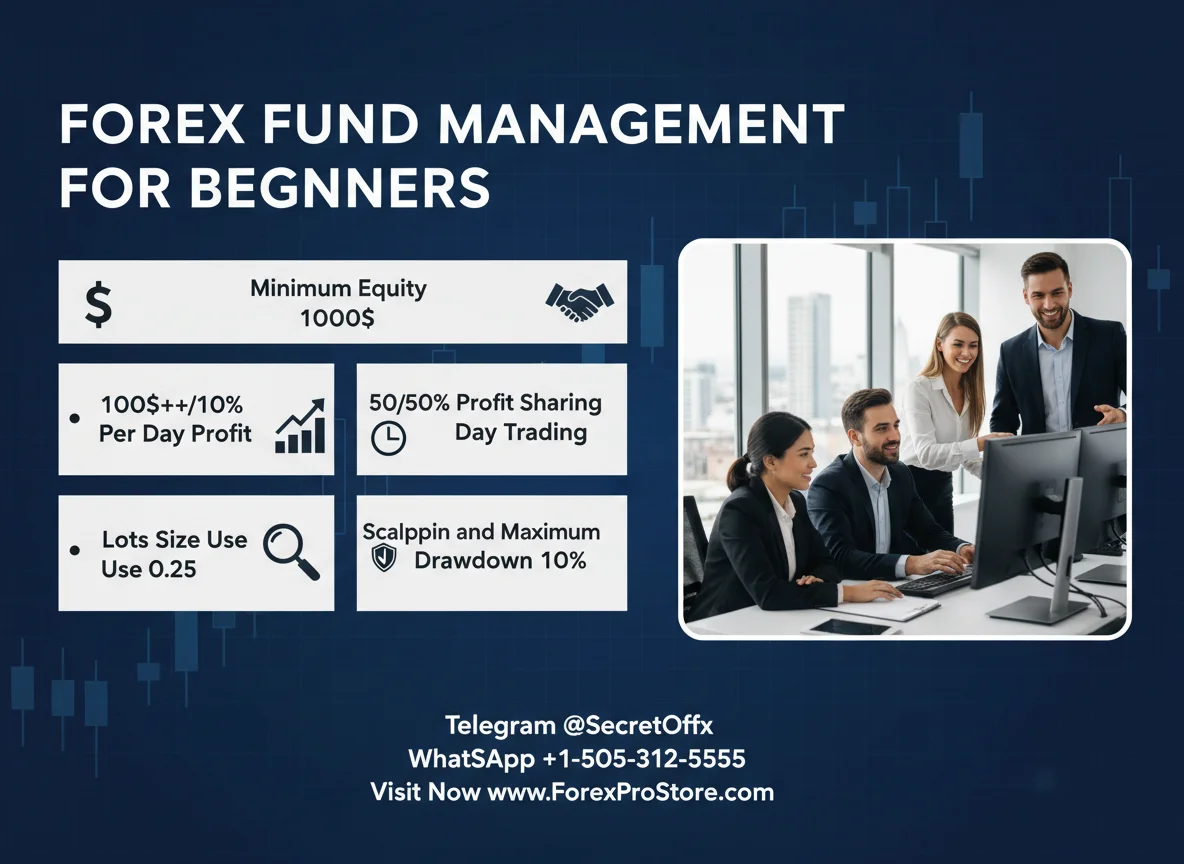
Download Now Non-Repaint Indicator
Telegram Channel Visit Now
Fund Management Services Visit Now
14. Conclusion
Forex fund management is not a magic ATM for beginners. It is a sophisticated financial ecosystem filled with brilliant algorithmic quants, steadfast risk managers, and, unfortunately, a heavy population of marketers and charlatans.
Your success in this space does not depend on your ability to read a chart; it depends entirely on your ability to read people, analyze data, and enforce strict boundaries. Treat the selection process like you are a CEO hiring a Chief Financial Officer. Demand verification, scrutinize their failures, and prioritize the defense of your capital above the promise of extreme returns.